

Showing posts with label claude shannon. Show all posts
Showing posts with label claude shannon. Show all posts
Steve Fly On The Tale Of The Tribe (Reading From TSOG)
Join me for a building session at
https://www.patreon.com/stevefly
Rock on.
--Fly
re:publica 2015 - Cory Doctorow: The NSA are not the Stasi: Godwin for mass surveillance
Published on May 7, 2015
Find out more at: http://re-publica.de/session/nsa-are-...
It's tempting to compare NSA mass surveillance to the GDR's notorious Stasi, but the differences are more illuminating than the similarities.
Cory Doctorow
Electronic Frontier Foundation
Creative Commons Attribution-ShareAlike 3.0 Germany
(CC BY-SA 3.0 DE)
It's tempting to compare NSA mass surveillance to the GDR's notorious Stasi, but the differences are more illuminating than the similarities.
Cory Doctorow
Electronic Frontier Foundation
Creative Commons Attribution-ShareAlike 3.0 Germany
(CC BY-SA 3.0 DE)
Email To The Tribe (A Youtube Playlist Refresher)
Email to the tribe is my research class into the tale of the tribe, paying tribute to the last great work of Dr Robert Anton Wilson.…
http://ettt.wikispaces.com/
www.raw360.net
--Steve Fly
http://ettt.wikispaces.com/
www.raw360.net
--Steve Fly
SEMIOTIC MACHINES: by Louis Armand (Joyce, McLuhan, Shannon, Weiner, Von Neumann)
SEMIOTIC MACHINES: by Louis Armand, presents a number of passages that see James Joyce, McLuhan, Shannon, Weiner, Von Neumann, criss-crossing and pollinating the tale of the tribe with a Joycean, atomic, digital glossing. Also invoking Orson Welles through the reference to expanded cinema of Gene Yougblood, this essay exhibits the highest standards of critical writing on Joyce IMHO, and in the kind of prose i would like to see utilized to help explicate the questions of the tale of the tribe as defined by Robert Anton Wilson, Ezra Pound, Buckminster Fuller, and Joyce.--Steve fly
Above all, the importance of Joyce for McLuhan resides in the decisive role of Finnegans Wake in re-defining the late stages of print culture and the advent of digiculture (the so-called “postmodern moment”). In this sense, Joyce’s text assumes a pre-eminent status among the agents and historians of late modernity—among them John von Neumann, Norbert Wiener, Claude Shannon, Lewis Mumford and Siegfried Giedion—and, along with the Mallarméan critique of the book and Marcel Duchamp’s satirisation of mechanical rationalism, the Wake becomes something of a benchmark in the early discourse of cyberspace.
Joyce’s technique of “verbivocovisual presentement”(5)—reprising the symbolist preoccupation with effects of synaesthesia—bears directly upon the conceptualisation of virtual reality and emersive signifying environments. Gene Youngblood’s Expanded Cinema (1970?), which proposes the integration of computing technology and other forms of telecommunications for the synaesthetic and syncretistic expansion of film, is heavily indebted to McLuhan’s reading of Finnegans Wake in Understanding Media (1964) and The Gutenberg Galaxy (1962). “The stripping of the senses and the interruption of their interplay in tactile synaesthesia,” McLuhan writes, “may well have been one of the effects of the Gutenberg technology”—of which Finnegans Wake is considered a kind of apotheosis.(6)
http://hjs.ff.cuni.cz/archives/v8/main/essays.php?essay=armand
TTOTT 2013: Go git' yr' pens and pads
TTOTT 2013 by Steven 'fly' Pratt.
Some of my readers, and a small portion of friends may be familiar with Robert Anton Wilson and his tale of the tribe, but, alas i imagine that most are not. If you stumbled upon this writing, and are out of facebook well done, I dearly wish you might give me a chance to turn you on.
Some of my readers, and a small portion of friends may be familiar with Robert Anton Wilson and his tale of the tribe, but, alas i imagine that most are not. If you stumbled upon this writing, and are out of facebook well done, I dearly wish you might give me a chance to turn you on.
Shannon Info, Jung-Paul Synchro, digital holographic DNA cosmology stuffing
it's a long wynding story, if you wanna' likkle primer, watch this short video about Claude Shannon. I see this being useful as providing a framework (Shannon's infomation theory) for thinking about human DNA RNA synthesis, and calculating better--more efficiently--so as to speed up the emerging DNA based medicine and therapy. It could be useful for every single aspect of human biological medicine, and at the same time, makes an explicit link between 'digital bits' and 'the biological 'binary' aspects of biology. '
So, to continue on this tip, and explain myself a little, it's been my hunch over the last 3 or so years that the 'holographic principle' co-founded by Dutch Nobel prized physicist: 'Gerard t'hooft' and 'information theory' as developed by Claude Shannon, underly a somewhat hermetic 'unified theory'. The above link to DNA sequencing, and the following link to 'cosmological' BIT Theory, if you like, are examples for the seriousness of this pretty 'far out' idea that, in some sense, the whole universe seems contained within each atom! or you could say a 'Digital' Universe, or better yet Multi-verse. As above, a new 'Digital' DNA information theory, and below:
"Hogan’s noise arises if space is made
of chunks. Blocks. Bits. Hogan’s noise would imply that the universe is
digital."http://
p.s Physicist Jack Sarfatti has proposed similar idea's that include Shannon's maxim's, and a neurological-cosmological ratio. I picked up on these ideas via Dr Robert Anton Wilson, who I suspect picked up some of these ideas from Jack, Saul Paul Sirag, David Bohm and others from the now legendary Bay Area based 'Physics Consciousness Research Group' that he attended. --Steve Fly
GOD IS IN THE NEURONS: A DOCUMENTARY EXPLAINING 'MIRROR NEURONS, OR EMPATHY NEURONS:
Shannon's Mathematical Theory of Communication Applied to DNA Sequencing
If we could have James Joyce and Robert Anton Wilson in the mix we might get close to something very really close to 'the tale of the tribe'. With a focus on RAW's book 'Coincidance' in which he defines DNA based information theory through a Joycean measure of the redundancy of information, poetry as information, political speeches as low. love, fly.
Shannon's Mathematical Theory of Communication Applied to DNA Sequencing
Nobody knows which sequencing technology is fastest
because there has never been a fair way to compare the rate at which
they extract information from DNA. Until now.
kfc 04/02/2012
- 2 Comments

One of the great unsung heroes of 20th-century science is Claude Shannon, an engineer at the famous Bell Laboratories during its heyday in the mid-20th century. Shannon's most enduring contribution to science is information theory, which underpins all digital communication.
In a famous paper dating from the late 1940s, Shannon set out the fundamental problem of communication: to reproduce, at one point in space, a message that has been created at another. The message is first encoded in some way, transmitted, and then decoded.
Shannon's showed that a message can always be reproduced at another point in space with arbitrary precision provided noise is below some threshold level. He went on to work out how much information could be sent in this way, a property known as the capacity of this information channel.
Shannon's ideas have been applied widely to all forms of information transmission with much success. One particularly interesting avenue has been the application of information theory to biology--the idea that life itself is the transmission of information from one generation to the next.
That type of thinking is ongoing, revolutionary, and still in its early stages. There's much to come.
Today, we look at an interesting corollary in the area of biological information transmission. Abolfazl Motahari and pals at the University of California, Berkeley, use Shannon's approach to examine how rapidly information can be extracted from DNA using the process of shotgun sequencing.
The problem here is to determine the sequence of nucleotides (A, G, C, and T) in a genome. That's time-consuming because genomes tend to be long--for instance, the human genome consists of some 3 billion nucleotides or base pairs. This would take forever to sequence in series.
So the shotgun approach involves cutting the genome into random pieces, consisting of between 100 and 1,000 base pairs, and sequencing them in parallel. The information is then glued back together in silico by a so-called reassembly algorithm.
Of course, there's no way of knowing how to reassemble the information from a single "read" of the genome. So in the shotgun approach, this process is repeated many times. Because each read divides up the genome in a different way, pieces inevitably overlap with segments from a previous run. These areas of overlap make it possible to reassemble the entire genome, like a jigsaw puzzle.
That smells like a classic problem of information theory, and indeed various people have thought about in this way. However, Motahari and co go a step further by restating it more or less exactly as an analogue of Shannon's famous approach.
They say the problem of genome sequencing is essentially of reproducing a message written in DNA, in a digital electronic format. In this approach, the original message is in DNA, it is encoded for transmission by the process of reading, and then it is decoded by a reassembly algorithm to produce an electronic version.
What they prove is that there is a channel capacity that defines a maximum rate of information flow during the process of sequencing. "It gives the maximum number of DNA base pairs that can be resolved per read, by any assembly algorithm, without regard to computational limitations," they say.
That is a significant result for anybody interested in sequencing genomes. An important question is how quickly any particular sequencing technology can do its job and whether it is faster or slower than other approaches.
That's not possible to work out at the moment because many of the algorithms used for assembly are designed for specific technologies and approaches to reading. Motohari and co say there are at least 20 different reassembly algorithms, for example. "This makes it difficult to compare different algorithms," they say.
Consequently, nobody really knows which is quickest or even which has the potential to be quickest.
The new work changes this. For the first time, it should be possible to work how close a given sequencing technology gets to the theoretical limit.
That could well force a clear-out-dead-wood from this area and stimulate a period of rapid innovation in sequencing technology.
Ref: arxiv.org/abs/1203.6233: Information Theory of DNA Sequencing
http://www.technologyreview.com/blog/arxiv/27689/



Bit By Bit, 'The Information' Reveals Everything
http://www.npr.org/player/v2/mediaPlayer.html?action=1&t=1&islist=false&id=134366651&m=134371366
March 8, 2011
The Information, written by James Gleick, covers nearly everything — jungle drums, language, Morse code, telegraphy, telephony, quantum mechanics, thermodynamics, genetics and more — as it relates to information, which he describes as the "fundamental core of things." Information theory can now be seen as the overarching concept for our times, describing how scientists in many disciplines see a common thread to their work.
Gleick's book spans centuries and geographic locations, but one person stays throughout the story for almost 400 pages: Claude Shannon, an engineer and mathematician who worked at Bell Labs in the mid-20th century. Shannon created what is now called information theory, Gleick tells Robert Siegel on All Things Considered:
"He was the first person to use the word 'bit' as a scientific unit of measuring this funny abstract thing that until this point in time scientists had not thought of as a measurable scientific quantity."
Bits are more commonly recognized as the 1s and 0s that enable computers to store and share information, but can also be thought of in this context as a yes/no, either/or or on/off switch. Gleick describes the bit as "the irreducible quantum of information," upon which all things are built.
Just like Isaac Newton took vague words like "force" and "mass" that had fuzzy contemporary meanings and turned them into specific mathematical definitions, "information" now can refer to a specific scientific definition similar to a bit.
"Binary yes or no choices are at the root of things," Gleick explains. The physicist John Archibald Wheeler coined an epigram to encapsulate the concept behind information theory: "It from bit." It described the idea that the smallest particle of every piece of matter is a binary question, a 1 or a 0. From these pieces of information, other things could develop — like DNA, matter and living organisms. The field of information theory, in addition to creating new meanings for words like "information," also builds upon knowledge from other scientific disciplines such as thermodynamics, even though the result may be a little tough to understand.
James Gleick also wrote Chaos: Making a New Science, which popularized the idea of the butterfly effect. His books have been finalists for the Pulitzer Prize and the National Book Award.
Phylis Rose
James Gleick also wrote Chaos: Making a New Science, which popularized the idea of the butterfly effect. His books have been finalists for the Pulitzer Prize and the National Book Award.
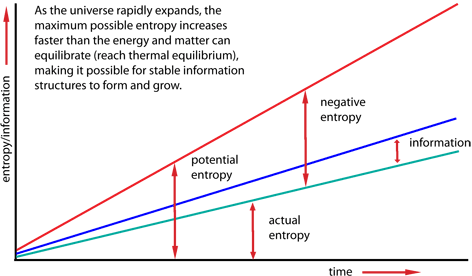
"When Claude Shannon first wrote his paper and made a connection between information and the thermodynamic concept of entropy, a rumor started around Bell Labs that the great atomic physicist John von Neumann had suggested to Shannon, 'Just use the word entropy — no one will know what you're talking about, and everyone will be scared to doubt you.' "
Though it may be a difficult subject to conceptualize, entropy does have a deep connection to information science, Gleick says. Entropy is associated with disorder in thermodynamic systems, and analogously so in informational systems. Though it may seem paradoxical to link information to disorder, Gleick explains that each new bit of information is a surprise — if you knew what a particular message contained, there would not be information in it.
"Information equals disorder, disorder equals entropy and a lot of physicists have been both scratching their heads and making scientific progress ever since," Gleick says.
In the everyday — not scientific — sense, an object like the moon only seems to contain information when we perceive it and develop thoughts about it, whether that's the man in the moon, the moon being made of cheese or the moon driving people to madness. But Gleick says that even without our perceiving it, the moon is more than just matter — it still has its own bits of intrinsic information.
"It sounds mystical, and I can't pretend that I fully understand it either, but it's just one of the many ways in which scientists have discovered a conception of information that helps them solve problems in a whole range of disciplines."
We can see now that information is what our world runs on: the blood and the fuel, the vital principle. It pervades the sciences from top to bottom, transforming every branch of knowledge. Information theory began as a bridge from mathematics to electrical engineering and from there to computing. What English speakers call "computer science" Europeans have long since known as informatique, informatica, and Informatik. Now even biology has become an information science, a subject of messages, instructions, and code. Genes encapsulate information and enable procedures for reading it in and writing it out. Life spreads by networking. The body itself is an information processor. Memory is stored not just in brains but in every cell. No wonder genetics bloomed along with information theory. DNA is the quintessential information molecule, the most advanced message processor at the cellular level—an alphabet and a code, 6 billion bits to form a human being. "What lies at the heart of every living thing is not a fire, not warm breath, not a 'spark of life,'" declares the evolutionary theorist Richard Dawkins. "It is information, words, instructions. . . . If you want to understand life, don't think about vibrant, throbbing gels and oozes, think about information technology." The cells of an organism are nodes in a richly interwoven communications network, transmitting and receiving, coding and decoding. Evolution itself embodies an ongoing exchange of information between organism and environment.
"The information circle becomes the unit of life," says Werner Loewenstein after thirty years spent studying intercellular communication. He reminds us that information means something deeper now: "It connotes a cosmic principle of organization and order, and it provides an exact measure of that." The gene has its cultural analog, too: the meme. In cultural evolution, a meme is a replicator and propagator—an idea, a fashion, a chain letter, or a conspiracy theory. On a bad day, a meme is a virus.
Organization theory and Claude Shannon
Organization theory
In 1988, on the basis of Shannon's definition of statistical entropy, Mario Ludovico[19] gave a formal definition of sintropy, as a measurement of the degree of organization internal to any system formed by interacting components. According to that definition, sintropy is a quantity complementary to entropy. The sum of the two quantities defines a constant value, specific of the system of which that constant value identifies the transformation potential. By use of such definitions, the theory develops equations apt to describe/simulate any possible evolution of the system, either toward higher/lower levels of "internal organization" (i.e., sintropy) or toward the system's collapse.http://en.wikipedia.org/wiki/Negentropy
email to the tribe: a Maybe Logic Class by Fly Agaric 23
Fly Agaric 23

September 20 - November 5
email to the tribe
Homogrammic Prose
Homogrammic Prose
The tale of the tribe approximates a tale of humanity, or 'tales', a new global epic that must capture illuminating details from humanity and juxtapose them in a special way using special language (Hologrammic prose, the Hermetic style, Ideogrammic method, Joyce's 'epiphany' etc.) Dr.Robert Anton Wilson crafted his tale of the tribe to suit, among other definitions; the architects of post-modem' cyber-culture, reaching back to the renaissance and pulling up-tense to our decentralized--hyper connected--future present.
During a six week period, I-fly will share his open interpretations of the tale of the tribe, performing an on-line multimedia vortex of signals, dialed into James Joyce, Ezra Pound, Giordano Bruno, Marshall Mcluhan, 'Bucky'Fuller, and RAW himself.
email to the tribe will reprocess communications from across time, and produce new maps, new metaphors, and mold new memes that help forward the tale of the tribe and the RAW wisdom oozing out from all quarters.
Each week fly will provide a spread of multimedia for you to process, generally keeping in step with the program, encouraging a wide variety of conversation and focused feedback. Feel free to drop in and drop out, as you like.
EMAIL TO THE TRIBE: WEEKLY PRESCRIPTION.
WEEK ONE - WHEELS AND CYCLES (Sep 20-26)
The wheels of the tribe go around and around.
WEEKLY DOSE: Decentralized and Rotational Map Warfare.
The wheels of the tribe go around and around.
WEEKLY DOSE: Decentralized and Rotational Map Warfare.
WEEK TWO - GENERAL EPIPHANY (Sep 27-3rd October)
Hologrammic Prose and meaningful common speech
WEEKLY DOSE: RAW-FLY interviews. (Oct 4-10)
Hologrammic Prose and meaningful common speech
WEEKLY DOSE: RAW-FLY interviews. (Oct 4-10)
WEEK THREE - IDEOGRAMMIC FULLERENE (Oct 11-17)
The synergy of history
WEEKLY DOSE: Vicosahedron and Canto LXVI. Open Source History.
The synergy of history
WEEKLY DOSE: Vicosahedron and Canto LXVI. Open Source History.
WEEK FOUR - GLOBAL FEEDBACK (Oct 18-24
If its not connected its useless
WEEKLY DOSE: Shannanigums Wave & Future Present.
If its not connected its useless
WEEKLY DOSE: Shannanigums Wave & Future Present.
WEEK FIVE - CINEMA OF UNITY (Oct 25-31)
Moving pictures to TV/Internet
WEEKLY DOSE: Maybe Logic & RAW Multimedia.
Moving pictures to TV/Internet
WEEKLY DOSE: Maybe Logic & RAW Multimedia.
WEEK SIX - THE TALE OF THE CYBERNET (Nov 1-5)
My-wiki-face-twitter
WEEKLY DOSE: Work of the tribe. email to the tribe.
My-wiki-face-twitter
WEEKLY DOSE: Work of the tribe. email to the tribe.
COURSE TEXTS: Recorsi by Robert Anton Wilson.
[$50 recommended minimum price]
http://www.maybelogic.org/courses.htm

RAW V.A.L.I.S JOYCE & HOLO-GRAMIC PROSE?
"One great part of every human existence is passed in a state which cannot be rendered sensible by the use of wideawake language, cutanddry grammar and goahead plot. --JAMES JOYCE, Referring to Finnegans Wake in a letter to Harriet Shaw Weaver (1926-11-24)"
I have a playman's or better yet ploughman's interest in physics, science and the paranormal, once again due for the most part to Dr. Robert Anton Wilson.
I was fortunate to meet many of the bright characters from the Berkeley Based Physics Consciousness Research Institute, where RAW was a somewhat regular alumni, with an irregular illumi.
I recently joined the new and improved http://www.stardrive.org/ a surprisingly interactive website hosted by Jack Sarfatti and friends, and a site I would suggest anyone interested in the physics-consciousness oriented writing of Robert Anton Wilson pay a visit. My interview with equally brilliant and Maverick thinker - Saul Paul Sirag - has been linked from said website to my surprise.
Here I'll simply contribute a number of papers available, or excerpts, that I feel help frame my interpretation of some of the content at stardrive.org and compare with some of the RAW's interpretations, if I may be so bold.
Philip K. Dick writes:
"Someday I'm going to get my artricle published; I'm going to prove that Finnegans Wake is an information pool based on computer memory systems that didn't exist until centuries after James Joyce's era; that Joyce was plugged into a cosmic consciousness from which he derived the inspiration for his entire corpus of work. I'll be famous forever. --Philp K. Dick, The Divine Invasion.

Robert Anton Wilson writes:
"As Bucky Fuller was quick to point out, the development of Information Theory by Shannon and Weiner enables us to see the human mind as the greatest synergy-machine, the greatest tool for doing-more-with-less, in this part of the universe.
Fuller points out that knowledge can only increase (except for tragedies like brain damage in an individual or totalitarianism in a society.) As our communication skills and information processing improve, human knowledge as a whole accelerates synergistically. Therefore, both hard and soft technologies accelerate – ideas and tools both change faster, faster, faster.--Robert Anton Wilson"
Please excuse the age and mixed context of these google-book I-FRAME presentations. Yet acting as a great resource and hub of helpful footnotes and research, we hope.
Gravitation and cosmology: from the Hubble radius to the Planck scale ...
By Richard L. Amoroso, Jean-Pierre Vigier, Geoffrey Hunter
The singularity is near: when humans transcend biology
By Ray Kurzweil
Developments in quantum physics.
By Frank H. Columbus
Our Superstring Universe: Strings, Branes, Extra Dimensions and Superstring ...
By Jr. L. E. Lewis
Explorations beyond the machine: a philosophy of social science for the post ...
By Ian Trevor King
Extreme Physics
By Scientific American (COR), Rosen Publishing Group
Cosmic catastrophes: exploding stars, black holes, and mapping the universe
By J. Craig Wheeler
And now, what I feel is one of the most important ingrediants to making star Trek real; Finnegans Wake by James Joyce and HOLOGRAMIC PROSE.
The Books at the Wake: A Study of Literary Allusions in James Joyce's ...
By James S. Atherton
AND FINALLY, FROM WIKIPEDIA:
Holographic principle:
The holographic principle is a property of quantum gravity and string theories which states that the description of a volume of space can be thought of as encoded on a boundary to the region—preferably a light-like boundary like a gravitational horizon. First proposed by Gerard 't Hooft, it was given a precise string-theory interpretation by Leonard Susskind.
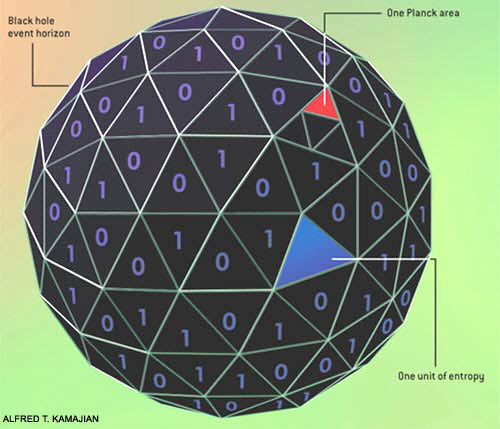
In a larger and more speculative sense, the theory suggests that the entire universe can be seen as a two-dimensional information structure "painted" on the cosmological horizon, such that the three dimensions we observe are only an effective description at macroscopic scales and at low energies. Cosmological holography has not been made mathematically precise, partly because the cosmological horizon has a finite area and grows with time.[1][2]
The holographic principle was inspired by black hole thermodynamics, which implies that the maximal entropy in any region scales with the radius squared, and not cubed as might be expected. In the case of a black hole, the insight was that the description of all the objects which have fallen in can be entirely contained in surface fluctuations of the event horizon. The holographic principle resolves the black hole information paradox within the framework of string theory. --http://en.wikipedia.org/wiki/Holographic_principleTwenty Twelve Line Verses v3.0 (Icosoheedrome)
Twenty Twelve Line Verses to 'the tale of the tribe' (v3.0) by Fly Agaric 23
To be printed as TWENTY TRIANGLES to build an Icosohedron.
Thanks to Mark Pesce for kicking this into 'hyperspace'
Thanks to Mark Pesce for kicking this into 'hyperspace'
Holographish Cubed Earwicker
Shannon
Maxim Fourier
Revolution Scientist
Communicate Microprocess
Complexity Coding Shannonbit
Mathematics Engineering MinimaxiMcLuhan
Psychology Reverse
The Medium is the message
Electronic Tribell Obsolete
Tetrad Diagram Retrieve Equation
Metamorpho Alfabetizz Handicraft
Harvard Professor
Psychedelic Poet
Neurologic Cyberpilot
Transpersonai Circuit Scientist
Engineering Imagination TransmissionerW i l l i a m
Astrology Laureate
Automatic Visionary
Legislatyr Playwrite Occultist
Silver AppleMoon Golden Applesun
Literature Wholopoem Mysticism
Great
Nietzsche
Return Pantheist
Philosophy Logic
Philologist Pastmoderniche
Existential Perspectivist Genius
Count
Alfred
Organism Binding
Aristopple Intraverse
William Burroughs Synergetic Fuller
Ash
Magic Memory
Giordano Nolan
Hermetical Quintessence
Decentralized Models Cyberspace
Humanitas Metempsychic Burnedatthestake
Art
Ernest
Francisco
Writing Japanheart
Oriental Scholar
Holowriting dossier
Ideogram Metaprogram
Historical Kulture Proffessor
Economic Symbolism Structuring
Imagists Knickerbocker Logowriting
Processing
Klassikspace
Klassikspace
Bio Computer
Cybernetic Peaceful Filter
Automation Thinking Humanist
Neuro-linguistic Minded Holismgram
Orson
Adaptation Cinemagick
Magnificent Macbeth Producer
Shakespearean Academy Screenplayer
Thunder Rhetoric
Historicist Ribelle
Graff
Spaceship Architect
Goes In For Structure Ezra Sez’
Energetic Synergetix Manual
Universail Tensegrity Geometry
Von
Negentropy
WarGame Zero Sum
Co-creator Internet
Revolutions Switching Fourier
Etching Digital Density Binary
Minimaxi Combinatrix Information
Wilhelm
Psychoanalyst
Imposition Orgone
Energetic Biofeedback
Omnipresent Dialectic Dynamo
SuperCosmic Energetic Psychiatry
Bio Interface
Cetacean Nation
Acoustical Linguistics
Interspecies Communication
Meditating Cogitate Repeats
Dyadic Cyclone Floatation mindtank
Computations Experiment Experience
Taxonomic McLuhan
Psychedelic Cyber Concressence
Panspermia Cyberculture Psilocybin
Bohemian Startrek
TTOTT TEXTS v2.0
ARGUABLY The greatest single resource for the study of DR. Robert Anton Wilson's tale of the tribe.
--Steve fly agaric 23.
--Steve fly agaric 23.
Marshall McLuhan: Renaissance for a wired world By Gary Genosko.
The medium and the magician: Orson Welles, the radio years, 1934-1952 By Paul Heyer.
The classic Noh theatre of Japan By Ernest Francisco Fenollosa, Ezra Pound
The legacy of Norbert Wiener By Norbert Wiener, David Jerison, Isadore Manuel Singer, Daniel W. Stroock
The virtual Marshall McLuhan By Donald F. Theall
Popular culture in a new age By Marshall William Fishwick
Vico and Joyce By Donald Phillip Verene
Science and sanity: an introduction to non-Aristotelian systems and general semantics By Alfred Korzybski
The Ezra Pound encyclopedia By Demetres P. Tryphonopoulos, Stephen Adams
Giordano Bruno and the geometry of language By Arielle Saiber
Giambattista Vico and Anglo-American science: philosophy and writing By Marcel Danesi
Beyond Good and Evil By Friedrich Wilhelm Nietzsche.
The New Anthology of American Poetry: Traditions and revolutions, beginnings... By Steven Gould Axelrod, Camille Roman, Thomas J. Travisano
The good European: Nietzsche's work sites in word and image By David Farrell Krell, Donald L. Bates
The Dragon Painter By Mary McNeil Fenollosa
At the speed of light there is only illumination: a reappraisal of Marshall McLuhan By John George Moss, Linda M. Morra
The Chinese Written Character as a Medium for Poetry: A Critical Edition By Ernest Fenollosa, Ezra Pound
From Whitney to Chomsky: essays in the history of American linguistics By John Earl Joseph
The imported pioneers: Westerners who helped build modern Japan By Neil Pedlar
Fearing the Dark: The Val Lewton Career By Edmund G. Bansak, Robert Wise
Spoken and written discourse: a multi-disciplinary perspective By Khosrow Jahandaríe
American literature and science By Robert J. Scholnick
The poetry of Ezra Pound By Hugh Kenner
Nietzsche: an introduction By Gianni Vattimo
News is people: the rise of local TV news and the fall of news from New York By Craig Allen
NOW YOLK. APOLLODELPHI THEATRE sketch v1.0
CUBEDOME


NOW YOLK. APOLLODELPHI THEATRE.
(JackY Muller, Manfred Humanski and James Shermon are talking about the CUBE).
JACK MULLER: A vectorial-edged cube collapses. The cube's corner flexibility can be frustrated only by triangulation. Each of the four corners of the cube's six faces could be structurally stabilized with small triangular gussets, of which there would be 24, with the long edge structurals acting as powerful levers against the small triangles. The complete standard stabilization of the cube can be accomplished with a minimum of six additional members in the form of six structural struts placed diagonally, corner to comer, in each of the six square faces, with four of the cube's eight corner vertexes so interconnected. These six, end-interconnected diagonals are the six edges of a tetrahedron. The most efficiently stabilized cubical form is accomplished with the prime structural system of Universe: the tetrahedron."

JAMES SHERMON: A method is developed for representing any communication
system geometrically. Messages and the corresponding signals are
points in two “function spaces,” and the modulation process is a
mapping of one space into the other. Using this representation, a
number of results in communication theory are deduced concerning
expansion and compression of bandwidth and the threshold
effect. Formulas are found for the maximum rate of transmission
of binary digits over a system when the signal is perturbed by
various types of noise. Some of the properties of “ideal” systems
which transmit at this maximum rate are discussed. The equivalent
number of binary digits per second for certain information sources is calculated.

JACKY MULLER: Because of the structural integrity of the blackboard or paper on which they may be schematically pictured, the cubically profiled form can exist, but only as an experienceable, forms-suggesting picture, induced by lines deposited in chalk, or ink, or lead, accomplished by the sketching individual with only 12 of the compression- representing strut edge members interjoined by eight flexible vertex fastenings.

JAMES SHERMON: If noise is added to the signal in transmission, it means
that the point corresponding to the signal has been moved a
certain distance in the space proportional to the rms value of
the noise. Thus noise produces a small region of uncertainty
about each point in the space. A fixed distortion in the
channel corresponds to a warping of the space, so that each
point is moved, but in a definite fixed way.
JACKY MULLER: The accomplishment of experienceable, structurally stabilized cubes with a minimum of nonredundant structural components will always and only consist of one equiangled and equiedged "regular" tetrahedron on each of whose four faces are congruently superimposed asymmetrical tetrahedra, one of whose four triangular faces is equiangled and therefore congruently superimposable on each of the four faces of the regular tetrahedron; while the four asymmetrical superimposed tetrahedra's other three triangular__and outwardly exposed__faces are all similar isosceles triangles, each with two 45-degree-angle corners and one corner of 90 degrees. Wherefore, around each of the outermost exposed corners of the asymmetrical tetrahedra, we also find three 90-degree angles which account for four of the cube's eight corners; while the other four 90-degree surrounded corners of the cube consist of pairs of 45-degree corners of the four asymmetric tetrahedra that were superimposed upon the central regular tetrahedron to form the stabilized cube.
ICOSAHEDRON:

JAMES SHERMON: We now consider the function of the transmitter from
this geometrical standpoint. The input to the transmitter is
a message; that is, one point in the message space. Its output
is a signal—one point in the signal space. Whatever form
of encoding or modulation is performed, the transmitter
must establish some correspondence between the points in
the two spaces. Every point in the message space must
correspond to a point in the signal space, and no two
messages can correspond to the same signal. If they did,
there would be no way to determine at the receiver which
of the two messages was intended. The geometrical name
for such a correspondence is a mapping. The transmitter
maps the message space into the signal space.

JACKY MULLER: In short, structurally stabilized (and otherwise unstable) cubes are always and only the most simply compact aggregation of one symmetrical and four asymmetrical tetrahedra. Likewise considered, a dodecahedron may not be a cognizable entity-integrity, or be rememberable or recognizable as a regenerative entity, unless it is omnistabilized by omnitriangulation of its systematic subdivision of all Universe into either and both insideness and outsideness, with a small remainder of Universe to be discretely invested into the system-entity's structural integrity. No energy action in Universe would bring about a blackboard-suggested pentagonal necklace, let alone 12 pentagons collected edge to edge to superficially outline a dodecahedron. The dodecahedron is a demonstrable entity only when its 12 pentagonal faces are subdivided into five triangles, each of which is formed by introducing into each pentagon five struts radiating unitedly from the pentagons' centers to their five comer vertexes, of which vertexes the dodecahedron has 20 in all, to whose number when structurally stabilized must be added the 12 new pentagonal center vertexes. This gives the minimally, nonredundantly structural dodecahedron 32 vertexes, 60 faces, and 90 strut lines. In the same way, a structural cube has 12 triangular vertexes, 8 faces, and 18 linear struts.

JAMES SHERMON: This type of mapping, due to the mathematician Cantor,
can easily be extended as far as we wish in the direction of
reducing dimensionality. A space of n' dimensions can be
mapped in a one-to-one way into a space of one dimension.
Physically, this means that the frequency-time product can
be reduced as far as we wish when there is no noise, with
exact recovery of the original messages.

JACKY MULLER: The vector equilibrium may not be referred to as a stabilized structure except when six struts are inserted as diagonal triangulators in its six square faces, wherefore the topological description of the vector equilibrium always must be 12 vertexes, 20 (triangular) faces, and 30 linear struts, which is also the topological description of the icosahedron, which is exactly what the six triangulating diagonals that have hypotenusal diagonal vectors longer than the square edge vectors bring about when their greater force shrinks them to equilength with the other 24 edge struts. This interlinkage transforms the vector equilibrium's complex symmetry of six squares and eight equiangled triangles into the simplex symmetry of the icosahedron.

Subscribe to:
Posts (Atom)