Showing posts with label poetry. Show all posts

What Is TANMOY?

 A new global epic (experiment) and culmination of everything at this blog and much more. Probably a quarter century research and development. Now, Tanmoy is here to bootstrap you in. Whatever it is, it's also an audio communication. Stay tuned as I post the Stanzas and reverse the order of things. 


TANMOY" is a new global epic poem that charts a journey through the history of human consciousness, from the cosmological visions of Giordano Bruno to the potential emergence of artificial general intelligence (ASI). It's a multi-layered, multi-voiced exploration of interconnectedness, the nature of reality, the power of information, and the transformative potential of technology. The poem grapples with fundamental questions about what it means to be human in a rapidly changing world, ultimately culminating in a vision of a unified consciousness that transcends individual limitations. The poem's narrative arc follows a chronological progression, but it's also structured around key themes and the interplay of different "Modes" or voices, each representing a specific figure or concept.

Core Ontology Knowledge Base:

"TANMOY" itself can be considered a core ontology knowledge base. It's a structured system of interconnected concepts, represented through language, symbols, equations, and code. It's designed for both humans and non-humans (like the ASI), offering a multi-faceted perspective on language.

Tale of the Tribe:

The poem is, at its heart, a "tale of the tribe" – a story of humanity's journey through time, its struggles and triumphs, its search for meaning and its relationship with technology. It encompasses the evolution of consciousness, from the earliest myths and sacred texts to the potential emergence of artificial general intelligence. The unique structure, the many modes, the multilingualism, all reflect the diversity of human experience and thought. In some sense a digital evolution of the oral tradition. A crazy poetry experiment by a drummer, dj, beatbox poet. Enjoy it.

#taleofthetribe #taleofatribe


Welcome to TANMOY. Mind your heads on the way out. Prompts and prayers. 

deepscratch.net 

GENRES: Mutant jazz. Little big band. Large Language Modal jazz. Beep Bop. Big Soul. Deep scratches. Tribetablism. MPHDJ cuts. Rainshroom rap. Token word. Slick, tight, funky drums. Updown beat. Sinnermatic soundscapes. Wake boxing. Canto tott trott. Blues, redefined: Tanmoy blues. Spew jazz bursts. Cosmic trigger word punctuations. Data set sax solos. Optihop energy. Optical street soul. Fly funk. Movie soundtrack vibe. Axiomatic jazz structures. Geometric classical elegance. Non von neumann swing. Non-being core philosophy. Data dust crew sound.
 

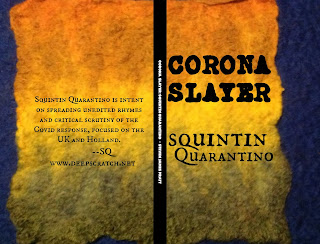
Corona Slayer And 2020 by Squintin Quarantino (Paperbacks)


I intended to collect 2020 Haiku poems into a book and publish it quarterly, after the world tilted toward a new trajectory due to novel coronavirus, as you will see, my writing shatters slowly returning to freestyle rhyme and longer pieces, trying to make meaning of the new world of 2020 and what lies beyond the horizons.

On reflection my first explicit mention of the virus is in the following lines from February 2nd: coronavirus / spreading like racism flu / check your prejudice / solidarity / with all east asian people / li sao for sorrow." These scrawls you track my attention moving with the spread of the virus and its potential impact and its dangers, within creative works and social media posts curated for your quarantainment, culled from blog poems, tweets and rants fresh.

For the record, my best guess is a Pangolin and a Bat spawned a new chimera near a Chinese a wet market, and since that moment power hungry greed heads have been trying to figure out how to twist the pandemic to forward their goals. Please consider my chronological diary of writings on Covid-19 as a testament to one individual trying to make sense of the available data. Stay safe, and keep supporting each other. Be nice. Thanks.

www.patreon.com/stevefly

2020: Squintin Quarantino by Steven James Pratt https://www.amazon.com/dp/B09JVMFD6V/ref=cm_sw_r_tw_dp_2XJ8FSAZDQN3WE1SNT5F via @amazon


PLUS


CORONA SLAYER By Squintin Quarantino (Poetry)
Corona Slayer: Squintin Quarantino by Steven James Pratt https://www.amazon.com/dp/B09JVM38N8/ref=cm_sw_r_tw_dp_A3Y18W8SHCEE49KHC814 via @amazon


Orientalism And Modernism - The Tale Of The Tribe

When I lived in New Orleans 2003-04 I was browsing a bookshop and stumbled upon the book "Orientalism and modernism" by Zhaoming Qian. The book travelled with me to New York, Chicago and back to the Bay Area and onto the UK, finally sitting on my shelf today, in Amsterdam. Everytime I go back to it I'm rewarded with enriched mental images. 


For any studying the tale of the tribe as outlined by Robert Anton Wilson, "Orientalism and Modernism" is my recommended introduction, getting at central themes such as being/non-being and contextualizing them in multicultural discourse orbiting poetry, the language of the tribe. 

This book, for me, reflects some of the reasons why Wilson included the relatively obscure scholar of far-eastern art and poetry: Ernest Fenollosa, in his dozen or so...historical modernist influencers (Bruno, Vico, Nietzsche, Yeats, Joyce, Pound, Korzybski, Fuller, Shannon, McLuhan, Welles)

I'd argue that some techniques employed by early Chinese poets predate the modernist tendencies and explorations of beingness, demonstrable/evidenced in the analysis of ellipsis, juxtaposition...plus symmetry with natural forms. Beautiful stuff. Toward a language of Daoism and quantum mechanics?       

 Good day.


--Steve Fly    


Author: Zhaoming Qian 

Subjects

Asian StudiesLiterature and Literary Studies > Literary Criticism

Chinese culture held a well-known fascination for modernist poets like Ezra Pound and William Carlos Williams. What is less known but is made fully clear by Zhaoming Qian is the degree to which oriental culture made these poets the modernists they became. This ambitious and illuminating study shows that Orientalism, no less than French symbolism and Italian culture, is a constitutive element of Modernism.
Consulting rare and unpublished materials, Qian traces Pound’s and Williams’s remarkable dialogues with the great Chinese poets—Qu Yuan, Li Bo, Wang Wei, and Bo Juyi—between 1913 and 1923. His investigation reveals that these exchanges contributed more than topical and thematic ideas to the Americans’ work and suggests that their progressively modernist style is directly linked to a steadily growing contact and affinity for similar Chinese styles. He demonstrates, for example, how such influences as the ethics of pictorial representation, the style of ellipsis, allusion, and juxtaposition, and the Taoist/Zen–Buddhist notion of nonbeing/being made their way into Pound’s pre-Fenollosan Chinese adaptations, CathayLustra, and the Early Cantos, as well as Williams’s Sour Grapes and Spring and All. Developing a new interpretation of important work by Pound and Williams, Orientalism and Modernism fills a significant gap in accounts of American Modernism, which can be seen here for the first time in its truly multicultural character.

The Pound Question: “Light lights in air”: Value, price, profit and Louis Zukofsky’s poetry By Andras Gyorgy


On the Pound question,
Quoted from the article “Light lights in air”: Value, price, 
profit and Louis Zukofsky’s 
poetry by Andras Gyorgy: 
(wiki links edited by steve fly)

The “Pound Question” is a complex one. At this stage we may conclude at the very least that his well-known fascist sympathy in the war and broadcasts on behalf of Mussolini need be set against his enthusiastic support of Zukofsky’s circle, mostly Jewish and avowedly Marxist. 
British painter and writer Wyndham Lewis, with whom Pound worked on the Vorticist magazine Blast in 1913-14, offered some insight into the American poet’s personality. Lewis called Pound, “A bombastic galleon, palpably bound to, or from, the Spanish Main. Going on board, I discovered beneath its skull and cross-bones, intertwined with fleurs de lys and spattered with preposterous starspangled oddities, a heart of gold.”
Pound had discovered the power of “movements” which consisted of little more than a manifesto, a special issue of a journal and an anthology. At his most enthusiastic, he would be praising and advising Zukofsky almost daily, sometimes more often, in letters, introducing his discovery to editors, giving him the benefit of his time, his wondrous editing, academic sponsorship. When his friend James Joyce was down on his luck, Pound sent him a pair of old shoes. According to Ernest Hemingway (in A Moveable Feast), Pound was “so kind to people that I always thought of him as a sort of saint.”
The touching relationship between Zukofsky and Pound, which did not cease in warmth and respect to the end of their days, is an aspect of the passing on of the modernist tradition to another generation of Zukofsky’s Objectivist circle, and then again through Robert Creeley and his generation, or “company” as he called it. 
Zukofsky fought for years to have “A” 1-12 (1959, 1967) in print. The poetic sequence Anew (1943), also the name of the collection of shorter poems that New Directions is bringing back, was the last volume that a publisher brought out for a very long time. A testament to Zukofsky’s mood during the long period of his neglect is the title of the sequence “Barely and Widely” (1962), which refers to Louis’ complaining to his soul mate Celia, as he often did, about how “barely” he was known and how “widely” neglected. This was true at least until many of the poets represented in Donald Allen’s very influential anthology, The New American Poetry (1959), discovered and championed him in their war against “academic” poets and the Eliot-inspired “New Criticism”, which ruled English departments after the Second World War.
https://www.wsws.org/en/articles/2016/02/03/zuko-f03.html

ALL sides defeated. WWI and TTOTT.

The Great War (not so great in my humble opinion) has been an ongoing part of my study into the tale of the tribe, pivoting on the poetry and prose of Ezra Pound and James Joyce, who both lived through WW1, and who both lost friends.

I understand, and respect why we have a period of silence in memory of those fallen, but i fail to understand why so few of the silent care to engage in the search for the main causes of war, or pay much attention to those who are brave enough to go there, into the complexity of the deep politics of war. To exhibit constructive criticism of authority, the industrial political economic war machine, those who make the guns and bombs and bullets, and sell them. And the apathy of the public, the sleeping masses who seem hoodwinked into supporting this monstrous killing machine in the name of patriotism. Or at least, not yet motivated to stand proud and say I AM AGAINST WAR, ALL WAR. And in saying that, imply a favour for life over death, compassion and sympathy, not hate and retribution.

I favour an interconnected global network of co-operative humanity, not annexed and isolated sovereign states fighting over material wealth, atoms, oil and arms. Like weasels fighting in a hole, as Willy Yeats described war.

Maybe...lets remember all our ancestors, ALL of them, and their struggles in a life lived against all the odds to bring us here. Stop the wars for our futures present sake. Stop the arms dealers. Or perhaps sign a petition, or star speaking out against the trident nuclear submarine plans? "Its a pity that ALL nations couldn't be defeated"--Ezra Pound, letter to James Joyce concerning the slaughter of WW1

A memorable line lifted from the Roman poet Horace, and used by the British Poet Winifred Owen: Dulce et decorum est Pro patria mori. “It is sweet and fitting to die for one’s country.” sounds to me, today, like the mantra of a maniac suicide bomber. What do you think? "1,2,3,4 what are we fighting for?"--Country Joe. As Ez wrote: the youth of WW1 have died “For an old bitch gone in the teeth, / For a botched civilization, / … / For two gross of broken statues, / For a few thousand battered books.” Peace means peace. Man! Look into the causes of war to oppose escalations of war. And yes, make room to honor the dead, all of them on all sides, love all the people. There is a time for silence and a time to speak. I suspect we could do with some more strong anti-war voices, poets, artists and perhaps a politician or two? with a basis in humanitarian principles, no fear, and a whole lot of luck. Fear leads to hate, as Yoda said. Yes mate. Steve Fly

BBC Radio 3: The Trial Of Ezra Pound

BBC Radio 3, Sunday, 20 Jul 2008, 21:30.
"To mark 2008's 50th anniversary of his release, historian Sean Street investigates how Ezra Pound, one of the 20th century's most important poets, was accused of treason by the US Government and held for years in a mental hospital after he made a series of anti-American and anti-Semitic broadcasts in Italy.
The programme investigates the significance of the case today, asking whether he committed treason or inconveniently used his right to free speech. With contributions from Pound's daughter Mary de Rachewiltz, his biographer David Moody and the playwright Bernard Kops, who wrote a play about Pound, in order to find out how we should view the complex and controversial poet."


poets who spoke in poetic characters' Vico and the artificer

While modern theories of knowledge begin with something present to the mind - e.g., Descartes begins with self-evidently true, clear, and simple innate ideas - Vico, begins by asking how it is that the mind comes to have anything present to it at all (Verene, 1981).
And it is precisely to this question that Vico claims to have an answer, indeed, it is the master key of his science. "We find," he says,
"that the principle of these origins both of languages and of letters lies in the fact that the early gentile people, by a demonstrated necessity of nature, were poets who spoke in poetic characters. This discovery, which is the master key of this Science, has cost us the persistent research of almost all our literary life, because with our civilized natures we moderns cannot at all imagine and can understand only by great toil the poetic nature of these first men" (para.34, my emphasis).
But to understand what he means here by saying that the early people were, by necessity, poets (where the word "poet" is from the Greek poitetes = one who makes, a maker, an artificer), we must divide the process of making involved into two parts: i) the first, to do with the forming of a sensory topic, and ii) the second, with the forming of an imaginary universal which, from a 'rooting' in it, 'lends' the topic a determinate form.--John Shotter, CMN/UNH, http://pubpages.unh.edu/~jds/VicoNotes.htm

Fenollosa Pound Olson and the Chinese written character


"The first was Ernest Fenollosa's provocative essay 'The Chinese Wriiten Character as a Medium for Poetry.' He found the Pound-edited text of the essay in the latter's book Instigations and excitedly copied out its main arguments into his notebook that June. Fenollosa's account of the exhaustion of poetic qualities in modern discourse resulting from a degeneration of the original capacity of language to mime the physical processes, and his implicit advocacy of a return to the state of primal verbal immediacy, with words once again becoming instrumental to the creation of 'a vivid shorthand picture of the operations of nature,' held for Olson the same appeal it had for Pound before him.--Tom Clark, Charles Olson: The Allegory of a Poet's Life. pg. 103.


The Mohawk Club

Mohawk Artwork by CHU www.schudio.co.uk


The Mohawk Club

down
to gothamsterdam
city clouds curl
like hair parting
to reveal grey root
beneath

platinum breaking
through air
to reveal silver
moonlight
streaking down

solid rays bouncing
off the puddles
street amber
tiger lightning
shattered glass
outside
that stinky moon
eclipsed by rolling
marshmallows
snatching the eye
back

cracked street light
the car lamp &
reefer torch
burning the other
out
out in the night a red
streak of light
designates the
club: Mohawk

pot smoke blows
from tangled with jazz
steam seeping out
bop

skidoobie blam
from the doorway
a rocket launch site
wings flap n’ flutter
new squawrk

bop music lifting up
cityscape
up up town up
escape into air

buildings nearby
sway loose from their
footing notes
and rise up again
steamin’ with gargoyles
they break loose to the
beat away from the grey
concrete holds

sprouting feathers
bright green &
toucan yellow
big chief pink & gold

Mohawk
gracefully leaping off
into dark skies
blackened
looping like Monk

tiny pieces of the city
pulled away in the night
inside the club
it’s hip under hazy
lemon light
the honey-bop drips
juss’ keep on jumpin

leap frog kangaroos
peeps jiggin’ &
movin’ so hard
the floor boards
wriggle loose
bop bop

another
blam boom
doors & windows
poppin’ in their
frames musical
flames lap ears of
harlem cats

wreckin the joint
the wooden stage
an amplifier
be-bop battery power
surrounded by schmaze
of musical mojos

the club a
living moseum
exotic objects
resonate to music
the players play
talismans
a seemingly ad-hoc
collection of artefacts
from africa india asia
the Caribbean
the americas
& Indonesia
crammed into

one room covering every
inch of wall space
a pink mardi gras
Indian head dress
five pots of Robert Johnson
snake oil
perch on the shelf

several rusty
saxophones hooked
over water pipes
like docked space craft

a bunged-up
silver tuba
hunches behind the bar
a mirrored ice bucket

two trombones
hang from shark teeth
trumpets & clarinets
double as flower vases
on turntable tables

a native indian
shield-canvas
looms large
like jupiter behind
the stage
shells beads belts
& wires hang from
all quarters snaking the
room
original sheet music
portraits of jazz masters
handmade flyers hang
behind smoke tinted
glass in various
frames crooked &
dusty books
embroidered with shells
& reeds
guitar picks crocodile
teeth piano
keys ostrich feathers
& white buffalo hair

to the left a
double bass pulses
like a whale heart
spitting out notes
from its huge
bass-clef gut

swinging around a
spike-axis firmly rooted
into the ‘C’ flatted floor
a human ear
shaped instrument

a bulging be-bop
skyscraper
swaying to the up
tempo uptown music

the horse chestnut
upright has viper tooth
tuning fangs
atop its snake
head head head

a hybrid trap kit
sits centre stage
kick oil drum
snare
catch the beat

get hi
hat stand from old
gun barrels
hi-hat cymbals from turkey
crash china symbols
viper head sticks
& mohawk punk
brushes

to the right
of stage the turn
tables sit atop
a grand piano
the dj rig
includes a raven
headed diamond
tipped stylus

recycled confederate
gun surplus
a tomahawk mixer
dreams of vinyl
records nailed to walls
nicotine patches
where some were
pulled down
& played and never
returned

beside turntables
a small glockenspiel
silver bullet keys
split the eye in two

a microphone
stand of gun parts
mixed with
three tomahawks

some guitar strings
peppered with bright
feathers
& sea shells
the microphone

a shaved viper head
with a mohawk
its tail wiggling off
toward the sound
board

who or what is going
to take stage here
tonight in this
shrine to creativity

here underground
in gothamsterdam
just after 4:20
in the morning
--Steve Fly
08/13 Amsterdam,
Edited 13/12/13.

Panorawma for Robert Anton Wilson (2013)


Panorawma
(for Robert Anton Wilson)


handcrafted study
in every direction:
Robert Anton
Wilson’s 360
digital artefacts now
fly thru a CHU space, hand
drawn appliances
of raw sciences

fresh crafted platforms
state-of-the-art in house
to look around use fingers
gyroscope, arrows or mouse

visit Washington cash spill
illuminate, cool off
cook listen wash-up
go to pot or

grill, open calendoor
playback answer
machine

to zoom: pinch or use the + & - icon
aim beyond language
Into SPACE, go on

explore rich n’raw media
behind hots-pots
cooking
panorawma views
you choose

--Steven ‘fly’ Pratt. 23rd January 2013.
www.raw360.net

Rage, rage against the dying of the light

Do not go gentle into that good night--Dylan Thomas. 1951.

Do not go gentle into that good night,
Old age should burn and rave at close of day;
Rage, rage against the dying of the light.
Though wise men at their end know dark is right,
Because their words had forked no lightning they
Do not go gentle into that good night.
Good men, the last wave by, crying how bright
Their frail deeds might have danced in a green bay,
Rage, rage against the dying of the light.
Wild men who caught and sang the sun in flight,
And learn, too late, they grieved it on its way,
Do not go gentle into that good night.
Grave men, near death, who see with blinding sight
Blind eyes could blaze like meteors and be gay,
Rage, rage against the dying of the light.
And you, my father, there on the sad height,
Curse, bless me now with your fierce tears, I pray.
Do not go gentle into that good night.
Rage, rage against the dying of the light.
 
http://en.wikipedia.org/wiki/Do_not_go_gentle_into_that_good_night

These fought in any case" by Ezra Pound

"These Fought in Any Case"
by Ezra Pound


These fought in any case,
and some believing
pro domo, in any case .....

Died some, pro patria*,
walked eye-deep in hell
believing in old men's lies, then unbelieving
came home, home to a lie,
home to many deceits,
home to old lies and new infamy;
usury age-old and age-thick
and liars in public places.

Daring as never before, wastage as never before.
Young blood and high blood,
fair cheeks, and fine bodies;

fortitude as never before

frankness as never before,
disillusions as never told in the old days,
hysterias, trench confessions,
laughter out of dead bellies.
 

*The famous line from one of Horace's "Odes":
Dulce et decorum est pro patria mori ("Sweet and fitting it is to die for one's country.")

http://www.rjgeib.com/thoughts/fight/fight.html

Some Joyce/Pound 'News' items...


The Politics of Modernist Poetics: Ezra Pound, Amy Lowell and Imagism:


Imagism was the poetry of directness and distillation championed by Ezra Pound and Amy Lowell in the first years of the 20th century, reacting against the flowery verse of late Romanticism and urging poets to look to earlier models—like Sappho in ancient Greece and Li Po in 8th century China—to create a poetry of precise and powerful images, without any superfluous words or ornaments.

http://poetry.about.com/b/2011/10/19/the-politics-of-modernist-poetics-ezra-pound-amy-lowell-and-imagism.htm


Great literature will live on with or without a prize

With readability the watchword for the Man Booker prize, it's unlikely any of the literary greats would even get on to the shortlist
  • The Observer,  
  • Would James Joyce have ever made the Man Booker shortlist? Not, you guess, if the current crop of judges had anything to do with it. A Portrait of the Artist as a Young Man might have squeaked on, but Ulysses? Not a chance. "Readability" is the watchword of this year's panel, apparently, led by the former spy mistress, Dame Stella Rimington. Fellow judge and ex-MP Chris Mullin likes something with a "bit of zip".
    Given that the Booker is at heart a speed-reading contest for judges – 100-odd novels to read in a couple of months – it is not surprising that those poor unfortunates faced with the task favour books that can be tackled in a few swift hours. Eighty books in and counting, who would want to be confronted with Finnegans Wake?

    http://www.guardian.co.uk/commentisfree/2011/oct/16/observer-editorial-man-booker-prize?newsfeed=true 


    "Poetic possibilities

    Review by MARTIN SPICE


    Poet/editor Ezra Pound’s contribution to what we now know as The Waste Land was profound and is well documented. Many years ago, British publishers Faber & Faber released a facsimile transcript showing his comments and crossings out and he is frequently referred to, rightly or wrongly, as the architect of the poem. Those amendments and alterations are included in the app and can be seen alongside the final version of the poem. There are hours of interest here in examining just what Pound left in and took out.

    http://thestar.com.my/lifestyle/story.asp?file=/2011/7/5/lifebookshelf/9009337&sec=lifebookshelf


    Mad about the girl: Tate Liverpool's Alice in Wonderland show

    Alice Liddell inspired Lewis Carroll, whose books inspired a thousand art works. But are they any good? Adrian Searle heads down the rabbit hole at Tate Liverpool's new show
Alice Pleasance Liddell taken by Charles Dodgson aka Lewis Carroll 
The real Alice … Alice Pleasance Liddell taken by Charles Dodgson aka Lewis Carroll. Photograph: National Portrait Gallery London
 
Lewis Carroll, or rather the fictive world of Reverend Charles Lutwidge Dodgson, is firmly embedded in our culture. I am surprised no one has made a religion out of Alice. Perhaps they have.

She is also very much at large in Tate Liverpool. Here she is, here she isn't: in James Joyce's Finnegans Wake and in Jorge Luis Borges; in Jefferson Airplane's White Rabbit, and in the surrealist works of Max Ernst and Salvador Dalí. Alice captivated Virginia Woolf and Walt Disney, inspired Robert Smithson, Sigmar Polke and a host of better and worse visual artists. Characters from the Alice books, or rather their putative ancestors, can be found, according to Alberto Manguel (writing in a brilliant, short catalogue essay), in Hamlet and Don Quixote, in Kafka, Homer and the Bible. The influence of Carroll's creation can be found in sci-fi, detective fiction and philosophy, in pre-Raphaelite painting and in hard-arsed conceptualism. You can't shake Alice off.

http://www.guardian.co.uk/artanddesign/2011/nov/02/alice-wonderland-tate-liverpool-review?newsfeed=true


Versus TTOTT Versus


This tale begins when the record [1] spins to the days turn of Gio Bruno and his heretical sins. Learn em', 
turn em'. Seen by the clergy as a sheen against God and King, no center to things, he said, he said that everything spins (everything spins), they 'everything' sins. had to wait till late for Bucky synergy. 


Vico wrote recorso to describe a new course so the rotorio [2]of ages can turn through the pages of man, he made new gauges that span the historical myth of grammar, a geography of man, man as word, word as man. 

Nietszche killed ‘god’ in the name of his good and started a flood of eternal returns so that new thinking caps burned 

under this very moonlight, and the spider learns to spin a social web and define terms as we move into the Celtic twilight. Billyum Yeats and his Irish mates contact the spirit levels of French Symbolism, perfected synesthesia in times on National Amnesia, of the swift wit and synge'd tongue, Yeats carried Ireland on the tip of his song. And the mighty Joyce trots into the tale, like a Lion, a Lamb and a whale, Joyce enthralls the reading with multiple choice, a quantum prose of the Hermetic nose craft, a smell for the wave particle swell, a feel for the silk satin stockings and the hard stainless steel, hyper-fiction, genius diction, resolution of the contradiction, of life and of time, of love and what's above like that which is below. Yeats living with Ezra Pound in the smoke feet on the ground, Pound helps Joyce find a distributor for his voice, and a nice letter and short stories to better and butter the idle chatter and chortle of Tories. And Ernest Fenollosa's spirit enters the London melting pot, by way of a manuscript most American scholars forgot, handed to Ez by his Widow, a study in Chinese Poetry, a window, into new worlds of imagist beauty, film in translation [3], Noh play a thousand new ways to say amore'. Through the first world war these writers and more struggled against the banking dinosaur threat, and lost friends and would never forget the destruction and suffering war begot. Korzybski developed a science of meaning, a map of the ceiling of language and math, he put the heat on the scriptures, testing sentences for god, for truth, and shows the multiple choice voice of Joyce as a formula, mind body brain control structures and neuro-linguistic systems, to balance the romantics Korzybski helped to create General Semantics. Bucky Fuller did a similar thing with a similar swing, using math and science and philosophy to produce new systems, and Bucky made pistons, nuts, bolts and volts, Bucky made us think outside the box into the Icosa, look at LAW as a hidden variable, to balance the equation, technology versus the will to life of humanity, the science and sanity of Korzybski cast as innovative tools against fools on the war game trip. Bucky tripping up the bad man killers with alternative ideas, the mental resources spill out from Bucky's mind-spray of Synergy like 12 flavors of ice cream sources. Ez said Bucky went in for structure, but consumption is still done by animals. Yes the world should feel lucky to have had an inventor like Bucky, thinking for all of us, all on the bus, on a trip to enlighten us. Shannon shoots 'bits' into the tale like they were fired from a cannon aimed at you. Yes you, dear reader you know who you are by now, your a collection of 'bits' in the information age, a field of 'control' of various 'bits' of information, your the cybernetic navigator, alright mate, see you later. 'What are you doing' said Orson Welles to Marshall McLuhan, and our tale was wrapped up and bound with glue in. 'Keep chewing' Said McLuhan, "Keep going' said Orson. "Awesome" said McLuhan, "Those letters to Harold Innis, innit" said Orson. And internet came.      

footnote 1:
Terence and the singularity.....
Monk
RAW and Heretic Factor.
I-Ching and foundation for Singularity
Rather than Liebnitz, King Wen?

Software and Hardware.

Update your reality Operating system.
The Hierarchy of values.
Maybe leftfield scientists Shannon, 
Weiner, and Von Neumann
Bucky and 
McLuhan in the muddle


And Bruno, Vico, Joyce, Yeats and Ez on the
Rightside of the brain.


Orson Welles conducting the symphony.


Dr. Wilson and his Heretic factor

Hold out for a paradigm shift superior  to any 
singularity yet proposed

A RAW singularity or
(Non-simultaneously apprehended event)

      Coincidance: A Head Testicle

Information = surprise, Shannon and 
Joyce waltz to
Kurzweil Pounding the piano 
like Frank Bruno with his Weiner.


footnote 2:

‘V’ co.  Said the Fellow Gnosa, Pounding his Weiner down in the Welles Fuller’ McGluon’s Brew.

“Noh, Rejoyce” Said Fried Rick. 

“Cor’ Seb Ski?” said Shannanigum.

‘V’ for vicorecorsi." Said Ezybski 


footnote 3:

Philosophers David Chalmers at the Australian National University in Canberra, points out that “consciousness” is an ambiguous term since it can refer to a variety of phenomena. “Each of these phenomena needs to be explained, but some are easier to explain than others,” says Chalmers. “At the start, it is useful to divide the associated problems of consciousness into ‘hard’ and ‘easy’ problems. The easy problems of consciousness are those that seem directly susceptible to the standard methods of cognitive science, whereby a phenomenon is explained in terms of computational or neural mechanisms. The hard problems are those that seem to resist those methods.” Here’s David Chalmers on consciousness:
http://www.hplusmagazine.com/articles/neuro/are-we-zeroing-hard-problem-explaining-consciousness
 

c60 Buckminsterfullerene's and 2012 Geodesic Revolutions

I have a hunch, a Grunch, about Buckminster Fuller's innovations.

Lets make a new TTOTT football, based on the Buckminster Fuller "Carbon 60" structure, and featuring a new Hologrammic Language... that's what I think, or thought just earlier today after work.

A Football, everybody plays with a football, no? Lets make a TTOTT football and construct a TTOTT team (tribe), place them on a TTOTT field (map) and have them play the kind of games Herman Hesse envisioned for his 'Glass bead game', or.. whatever you like. Just play. Let us play.

The structure of buckminsterfullerene is a truncated (T = 3) icosahedron which resembles a soccer ball of the type made of twenty hexagons and twelve pentagons, with a carbon atom at the vertices of each polygon and a bond along each polygon edge. -- http://en.wikipedia.org/wiki/Buckminsterfullerene